
By Florencemary Nwabueze
Lagos— Wetech has urged Africa to transition from being mere consumers of Artificial Intelligence to builders of its own AI solutions to secure a seat at the global table and empower more women in leadership.
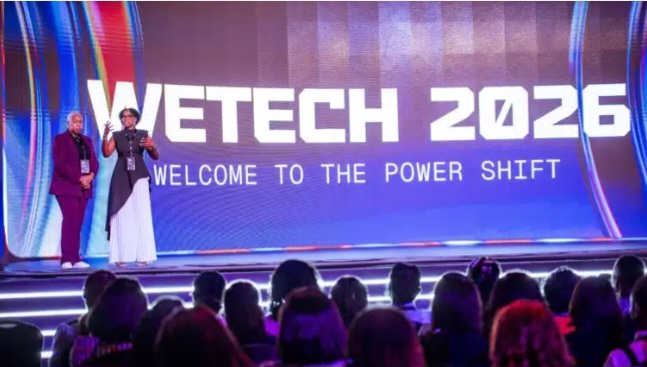
This charge was given during the Wetech 2026 flagship conference, themed "The Power Shift: Women Leading the Future of AI, Capital, and Innovation." The event, held on September 26th, 2026, at the Landmark Event Centre in Victoria Island, Lagos, brought together female tech professionals, founders, and investors from across the continent.
Flora Uwadiegwu, co-founder of Wetech, who spoke to our reporter during the event, expressed excitement about the initiative, stating she wants to see more women leading the charge in the growth of Africa's tech ecosystem.
"It's always great to see hundreds, thousands of women gather in one space where they can share their experiences and their journey,” Uwadiegwu said. “My hope is that whatever the women who came here today have learned, listened to, I want them to take that in and go home and build. I want them to think about all the information and connect the dots and try to create something that will improve our daily lives.”
According to her, any woman can be a leader, as there’s always an opportunity to lead, and if there's no space, she wants women to break through and create that space.
Africa’s overreliance on foreign models must stop
A panel that included Oremeyi Akah (Chief Customer Officer, Interswitch), Prof. Chika Yinka-Banjo (Director, AI Unipod, UNILAG), and Nneamaka Ihuoma (Head, Business Acquisition & Partnerships, Providus Bank) took the stage to discuss AI Moment, Partnerships & Talent for the Next Decade, moderated by Isioma Utomi, founder of Catalyst Experience Solution.
The panellists emphasised the need for Africa to own its data and build foundational models.
"The first thing we must get right here is that we must own our data,” Prof. Chika Yinka-Banjo said. “Data is the seed. The model we are all building is the tree. If you don't have the data, and you're using what you're fine-tuning from foreign models, it's not going to give you the main results."
The panellists argued that relying on foreign models trained on foreign data gives flawed results for African users. They stressed that Africa must move beyond consumption to developing the capability to build sustainable AI.
Nneamaka Ihuoma mentioned that a lot of the technologies that claim to be riding on AI are not homegrown, and without owning the intellectual property rights, Africa will remain consumers, who won’t be offered a seat at the table when real decisions are being taken.
“Africa must start, not just to consume and use AI solutions,” Ihuoma said. “We must go through research, education, and policy to start ensuring that we develop the capabilities to build our own intelligence here that we own."
She adds that technology should not be viewed as an end in itself but as a means to an end: first, identify the problem, then map the solution to the customer's context and reality.
Another panel, themed "From Policy to People: How Global & National Decisions Shape Women's Realities," focused on the often invisible impact of policy on women.
The panellists noted that most women do not realise how regulations shape their earnings, business opportunities, and access to technology. They advocated for having women in decision-making positions. They urge more women to use their voices, platforms, and creations to air their views, demand space at the table, or create a table and have more women on it.
"Women in Nigeria are half the population, but in the corporate world, women are only 29%,” Sade Dada said. “If you're not in the room where policies are being made, people who make it might not hate you, but they do not know how you feel about it."
The panellists also urged women to participate in policy conversations, emphasising the need for mentorship and sponsorship to ensure that women rise to the position of decision-makers. They encourage the sustainability of programs for women and the need for systemic interventions.
"If you're not in the room, there will be people in that room that will take those decisions for you and make assumptions that are not your reality," Morayo Adisa said.
Another discussion on "Building, Funding & Scaling as a Founder in Africa," featured Adesuwa Omoruyi (Co-founder, Accrue), Tosin Faniro-Dada (Partner, Breega), Oyindamola Oladosu (Principal, Boston Consulting Group-BCG), and Miishe Addy-Asare (CEO, Jetstream), moderated by Chinyere Inya (Managing Partner, Accelerate Africa & Itana).
The founders shared candid stories about pivoting, macroeconomic challenges, and the importance of understanding unit economics. Miishe Addy-Asare noted that Jetstream did not start generating significant revenue until they set aside the technology and began customising, and that it took about a year and a half before they understood where technology was relevant.
Adesuwa Omoruyi recounted how the 2022 macroeconomic conditions forced her company to pivot.
"At some point, the initial idea that we started with stopped working,” Omoruyi said. “You have to believe so much in that future that you're creating, because so many people will try to reject you for various reasons."
For Tosin Faniro-Dada, her advice was on the importance of founders knowing their numbers.
"You can be the best storyteller, but if you don't understand the numbers behind your business, it would be really difficult for me to believe and invest in you,” Faniro-Dada said. “I need you to understand your unit economics, customer retention, and your cohorts."
Winners at the PitchHer 2026
The highlight of the event was a pitch competition in which founders showcased their innovations.
Victoria Duru of Wakamedics emerged as the overall winner, receiving a ₦5 million prize. Blessing Aniefiok of Dynalimb Technologies was the 1st runner-up and was awarded ₦2.5 million. Ogunlana Misi of TFB Studios AI was the 2nd runner-up, winning ₦1 million.
Other pitch participants included Anjolaoluwa Ajayi, founder of ACADAI; Onyeka Nweze, founder of UNIKORRN; and Kamnsi Arachie, founder of JEWE Energy and Mobility.
The event also featured spotlight sessions on "Wetech Communities" and "Breaking into AI & Emerging Technologies," with speakers from Interswitch, Moniepoint, Google, PwC, Samsung, and others.