
By Florencemary Nwabueze
Telcables, a subsidiary of Angola Cables, has announced its ambitious plans to transform Nigeria's digital landscape through the launch of locally-hosted cloud infrastructure and artificial intelligence (AI) capabilities, addressing critical concerns around data sovereignty, cybersecurity, and the country's evolving digital economy, at a dinner held Friday in Victoria Island, Lagos.
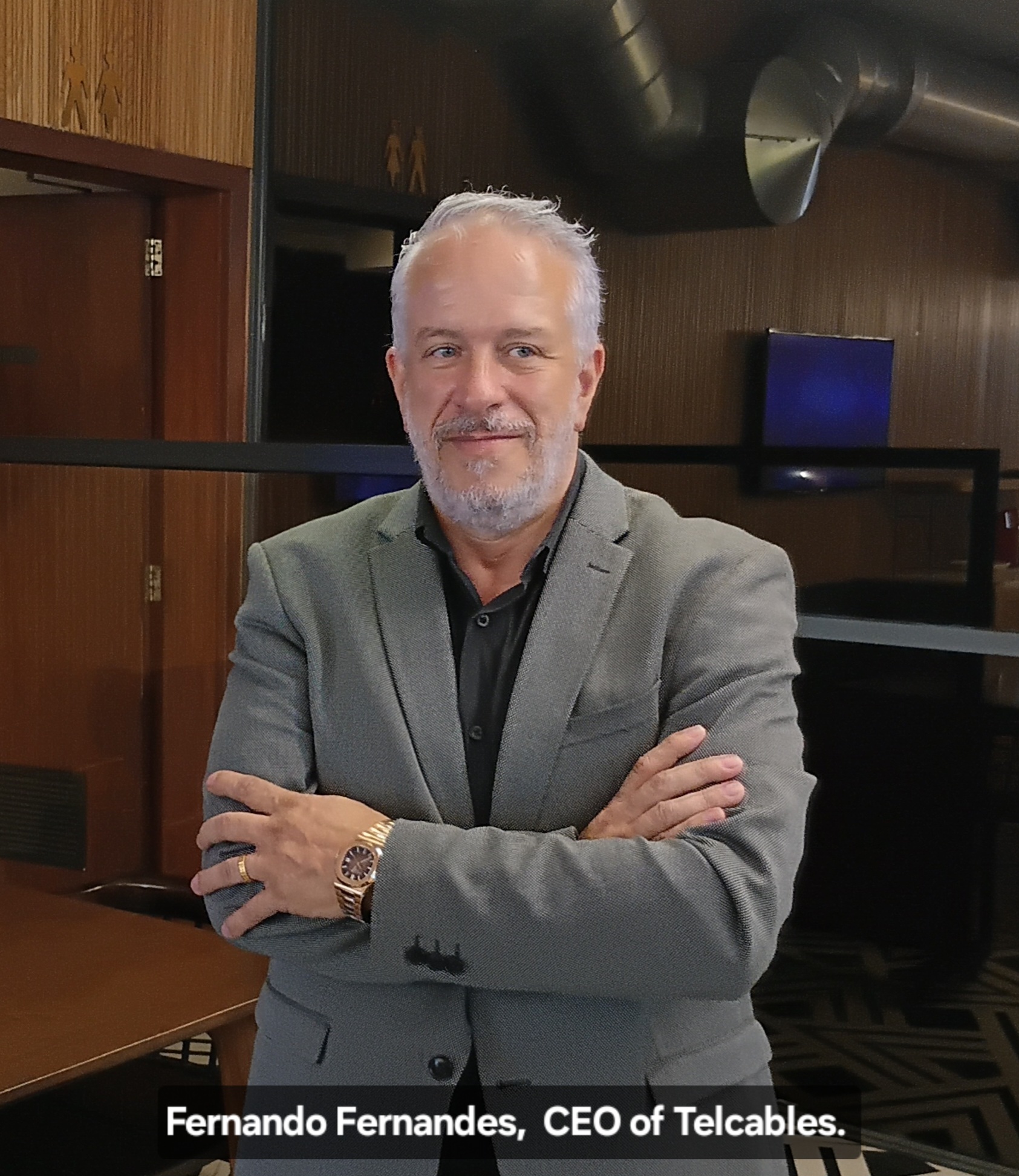
The event brought together key executives from the company, including Fernando Fernandes, CEO of Telcables by Angola Cables; Julio Chilela, Chief Digital Officer and Vice President of ICT for the group; Israel Ogboi, Pre-sales Engineer; and Babatunde, the company's lead sales executive.
At the heart of Telcables' announcement is the establishment of two locally-hosted cloud nodes in Nigeria, strategically positioned at RAC Centre and another facility on the mainland, both Tier 3 data centres that ensure power reliability and operational continuity. The company's cloud solution, branded "Class 2 Africa," offers Nigerian businesses the ability to store data locally, significantly reducing latency and eliminating international traffic costs.
"What we are bringing is sovereignty to the country, sovereignty to the companies. We want to bring data protection in various levels, not only bringing cloud nodes to the local country, but also bringing software solutions and AI to be local." Fernandes declared during his address.
The announcement comes at a critical time as Nigeria's Central Bank has mandated that all banks and fintech companies must localize their transaction data by January 1, 2026. Telcables has positioned itself as a ready partner for this transition, boasting certifications from Nigeria's National Data Protection Commission (NDPC) alongside international accreditations including ISO, SOC 1, and SOC 2.
Fernandes emphasized the company's commitment to data protection: "We didn't invent and place machines here only to serve, without having those things in place. We apply for certifications, not only with NDPC but also with ISO that are international. We are dealing with hyperscalers, and the hyperscalers don't leave things open."
A major highlight of the evening was the introduction of "Go4AI," a GPU marketplace and token factory launched at TechExpo. This platform allows Nigerian companies to train AI models and deploy private AI applications without exposing sensitive data to public AI systems.
Israel Ogboi, the company's Pre-sales Engineer, explained: "GPUs are quite scarce. So what we've done is bring this infrastructure local and provide this on different models to AI development companies. If you are a company making your own AI model that you need to train, you can leverage our GPU to train these models or host your AI in our GPU."
The platform enables organizations to create private AI assistants, effectively creating localized versions of popular AI tools that keep sensitive information within Nigeria's borders.
Julio Chilela, Chief Digital Officer, detailed Telcables' impressive infrastructure backbone, which includes ownership stakes in three major submarine cable systems: WACS (connecting Africa to Europe), SACS (connecting Africa to Latin America), and MONET (connecting Brazil to the United States). This network provides redundancy that proved crucial during the March 2024 cable cuts in Côte d'Ivoire.
"When a lot of cable systems went down, we were able to route traffic southbound to Angola, then use SACS to connect to Brazil, then through ELA-Link to Europe or MONET to the US," Chilela explained, demonstrating the resilience of their network architecture.
Addressing the unique value proposition, Fernandes outlined three key differentiators: services are denominated in Naira (eliminating forex exposure), businesses pay only for infrastructure used (with bandwidth and IP addresses provided at no additional cost), and all data remains within Nigeria.
"Every month they receive an invoice from these big players that charge them by the traffic they create," Fernandes noted. "With us, it's completely free."
The Telcables team outlined various use cases for their AI infrastructure across different sectors:
Banking: AI models for real-time fraud detection and customer verification, reducing transaction delays and errors.
Mining: Using AI to analyze aerial imagery for resource identification, requiring powerful local computing capabilities.
Public Sector: AI-powered call centres where citizen data remains within the country.
Cybersecurity: Training local AI models to detect and respond to network anomalies, essential as cybercriminals increasingly employ AI for attacks.
Addressing concerns about cross-border data sharing and regulatory relationships, Fernandes stressed that "all the information is not shared, even with our servers in Uganda or other countries."
The company has been actively working with NDPC to obtain necessary certifications and expects that regulatory processes will become more streamlined as AI adoption increases.
"Even all the government sectors, agencies, will go for that model. It's a question of adoption," Fernandes predicted. "I think the Nigerian people are very smart, very intrapreneur. This will leverage all the process, all the ecosystem, and they will contribute to having more and more resilient networks and systems in the market."
With a presence in four continents and a commitment to providing Africans with infrastructure built "by Africans to Africans," Telcables represents a significant shift in the continent's digital narrative.
Fernandes, who declared himself "a Pan-Africanist," concluded: "We don't like to copy and follow. We like to be followed." With its sovereign infrastructure now operational in Nigeria's most critical sector, the company appears well-positioned to lead Nigeria's journey toward digital autonomy and AI-driven economic growth.